
When Sky Global’s network went dark in March 2021, tens of thousands of users, from businesspeople and lawyers to journalists and privacy advocates, were left staring at dead screens. Overnight, their encrypted phones became expensive paperweights. But the real story wasn’t the sudden blackout, it was what came before it.
Months later, court filings revealed that law enforcement had been intercepting messages from Sky Global devices long before the takedown. In fact, it was close to two years and about 1 billion messages. Because of the encryption used, they were however unable to read these messages. That was until they recovered the encryption key from the server’s memory. Translation? Private communications from innocent users had been silently monitored. On top of that, they were also eavesdropping on LIVE communication for almost three months, before taking down the company.
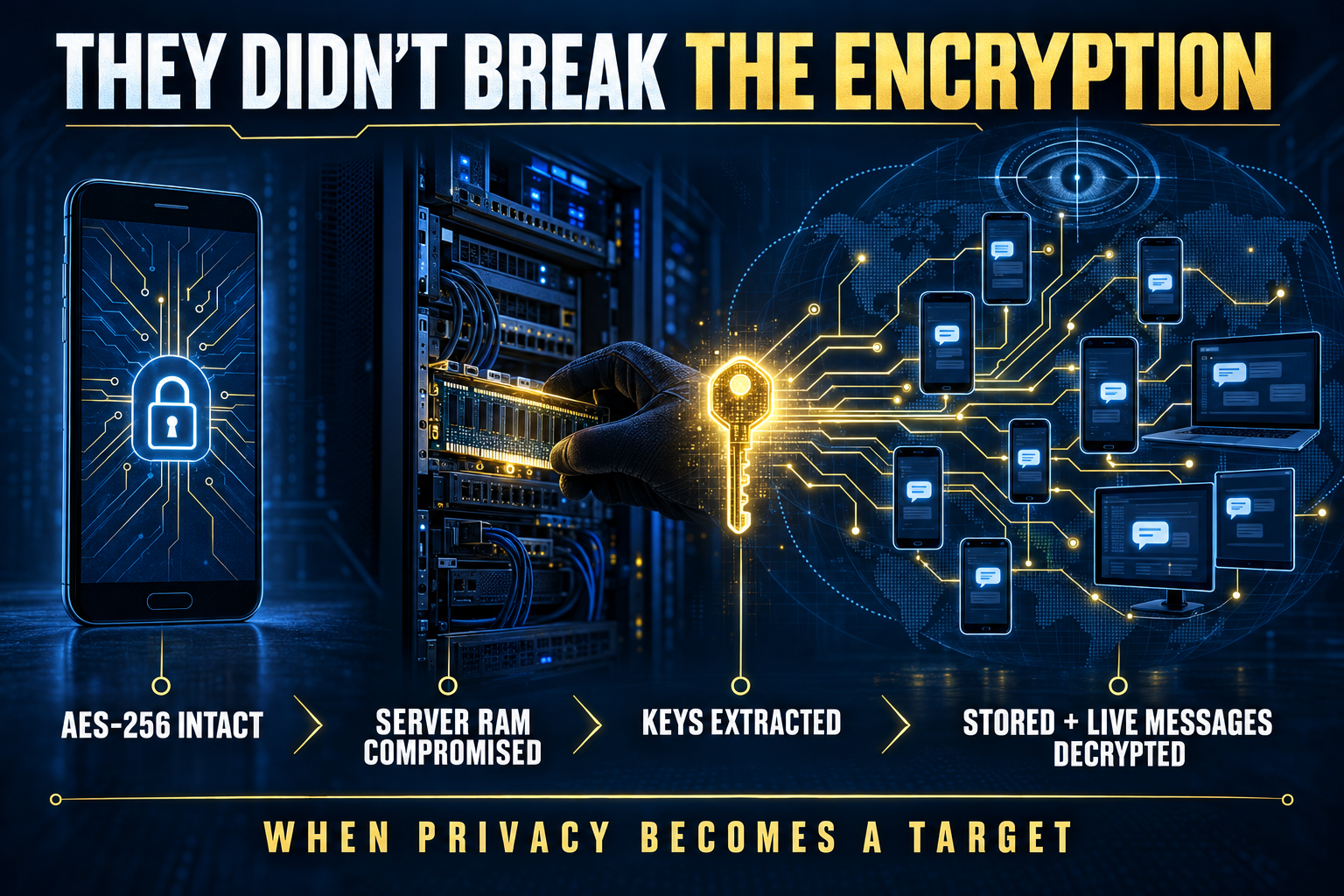
It wasn’t brute-force hacking. Sky’s encryption, based on AES-256, was far too strong to break with current computing power. Instead, investigators have gained internal access through servers’ RAM, from which they were able to copy and use the keys for decryption. They didn’t pick the lock; they somehow obtained the keys. The technical details of the operation remain classified (no big surprise there). What’s clear is that it opened a window into every device on the network, which was an act of mass surveillance disguised as an investigation.
Governments celebrated it as a victory against organized crime. Press releases praised “unprecedented cooperation” between agencies. But beneath the applause was a much darker truth: many of those whose messages were intercepted had committed no crime at all. The hypocrisy is hard to ignore. When criminals used BlackBerry’s BBM years earlier to coordinate illegal activities, no one called for BlackBerry’s shutdown. Yet Sky Global, a small Canadian company built on the ideal of personal privacy, was treated like a criminal cartel. The difference wasn’t technology: it was power, as Sky Global didn’t have lobbyists or legal armies. It only had principles. And that was enough to make it dangerous.
The Sky Global takedown created a precedent that should send a chill through the entire tech industry: If you build a tool that protects privacy, and someone uses it for crime, you can be treated as a criminal too.
By that measure, Ford (and other car manufacturers) should be liable for getaway cars. Apple should be responsible for phishing scams. And VPN providers should be prosecuted because hackers still use their services (daily!) for nefarious purposes..
Encryption is not the crime. It’s a defense against invasion of privacy. When privacy becomes suspicious, freedom becomes conditional, and once that line is crossed, there is no going back.
Lessons from the Shadows
When Sky Global was taken down, law enforcement around the world celebrated. Press conferences framed it as a victory for justice, a blow against organized crime. But the real message behind the operation was something far more unsettling: privacy now has limits, and those limits are defined not by law, but by power. What followed in Canada was even more alarming: silence.
Sky Global wasn’t some foreign rogue company. It was a Canadian firm, founded and headquartered in Vancouver, led by Jean-François Eap, a Canadian citizen who had never been convicted or proven guilty of any crime. Yet when the takedown came, few questioned it. There was no public debate, no outrage, no discussion in Parliament about what it meant for Canadian sovereignty, privacy, or technology innovation.
Canadian authorities found themselves without a legal instrument sharp enough to prosecute Sky Global under domestic law. Privacy, encryption, and communications services existed in a grey zone that Canada’s Criminal Code simply didn’t contemplate. So instead of rewriting the rules or testing the boundaries in Canadian court, law enforcement and their partners stretched the case south – all the way to Texas – to find a statute broad enough to fit their narrative.
It was the U.S. Department of Justice, not the RCMP, that ultimately filed the charges. Using American RICO and narcotics-conspiracy laws, prosecutors in the Southern District of California painted Sky Global as part of a criminal enterprise, a framing that let them seize domains, freeze assets, and claim jurisdiction over a Canadian technology firm operating legally at home. It was a legal workaround disguised as justice, proof that when national laws fall short, geopolitics often fills the gap.
According to former Royal Canadian Mounted Police intelligence analyst Scott McGregor (cited in the The Fifth Estate documentary) one trigger for the entire investigation appears to have been the German rapper Eno’s 2019 track “Blackberry Sky” 8 , which opens with the line:
“I write the price of my haze into my Blackberry
When you write me, never on WhatsApp, only on Blackberry Sky” 9
McGregor says investigators treated the lyrics as coded language. Ludicrous!
The U.S. indictment against Eap claimed that by selling encrypted phones, Sky Global “knowingly facilitated” criminal communication. But that claim was never tested in court. The company was dismantled before it had a chance to defend itself.
Eap’s stance was clear: Sky built tools for privacy, not for crime. He argued that individuals – not companies – should be held accountable for how they use the technology. But once the servers were seized and the company’s infrastructure destroyed, his side of the story effectively vanished. This is one of the reasons for this article: the story must be told and carried forward.
While the U.S. led the prosecution, Canadian authorities cooperated fully. Servers were seized, warrants coordinated, data shared, all with little transparency. If a Canadian company operating under Canadian law can be dismantled at the request of foreign authorities, what protection do Canadian citizens really have? Obviously… none.
Every day brings a new cybersecurity threat: ransomware, phishing, data breaches, deepfakes, digital espionage. Yet while we scramble to defend ourselves, our right to privacy is steadily being reframed as a threat to national security.
Encryption, which is the backbone of digital safety, is being treated as suspect technology. Politicians describe it as an obstacle. Law enforcement calls it “going dark.” But without encryption, everything from online banking to medical records to private conversations would be wide open. We need encryption, not because we have something to hide, but because we have something to protect. Something that we nowadays tend to believe doesn’t matter anymore.
Sky Global may be gone, but its story is not over. It lives on as a warning that once privacy is gone, we will never get it back.
The Future of Privacy and the Fight for Digital Freedom
The fall of Sky Global wasn’t just the end of a company, it was the start of a new era, one where privacy itself stands accused. For decades, encryption promised something simple and powerful: your data belongs to you. But after operations like EncroChat and Sky Global, that promise feels increasingly fragile. Governments didn’t just intercept communications; they rewrote the rules of engagement in cyberspace. They acted first, explained later, and declared victory.
The public, worn down by endless headlines about hackers and ransomware, quietly accepted it, and that quiet acceptance may be the most dangerous threat of all. We are now caught in a global arms race, not between nations, but between privacy and surveillance.
On one side stand technologists, journalists, and privacy advocates trying to protect personal data from theft, censorship, and misuse. On the other side are governments that insist no conversation should ever be completely private. Both sides claim to defend safety. But their goals couldn’t be more opposed. “If you have nothing to hide, you have nothing to fear.” mantra is being heard very often. But that’s not how freedom works. Privacy isn’t about secrecy – it’s about choice. The choice to decide who sees your thoughts, your words, your life. Once that choice is gone, what’s left isn’t safety, it’s control.
For Canada, this debate is just beginning: and Sky Global’s collapse should be our wake-up call. This was a Canadian company, operating under Canadian law, building Canadian technology. Yet when international pressure came, Canada cooperated quietly, offering no public defense, no investigation, no debate. If a Canadian innovator can be destroyed overnight without trial, what message does that send to the next generation of cybersecurity entrepreneurs?
To criminalize encryption because it can be misused is to criminalize privacy itself. The question isn’t whether bad actors will exploit secure systems (they always will). The question is whether free societies will abandon those systems out of fear. The way forward isn’t to ban privacy tools or weaken encryption “for safety.” It’s to demand accountability and transparency from those who wield power in the digital realm.
The story of Sky Global may be over, but its warning endures. Privacy can vanish overnight: taken by decree, erased by compliance. Rebuilding it, however, may take generations. If we don’t fight for it now, the future won’t belong to those who build the best technology, it will belong to those who control it.
They Didn’t Break the Encryption – They Broke the System
As a result of Europol’s Executive Director mandate, the institution planned and executed the interception and recording of over 160 000 devices – all under the assumption that all the device’s owners were criminals… even though law enforcement didn’t even know who these people were.
“My job is to fight crime, and we go after the criminals and after the tools criminals use to facilitate their business activities. We need to have access to the data.”
Catherine de Bolle – Executive Director, Europol 10
When police in Europe and North America announced the takedowns of EncroChat and Sky Global, it sounded like the climax of a spy thriller. Authorities claimed they had “cracked” encrypted phones used by organized crime networks across the world. Headlines called it proof that “no one is beyond the law.” But the real story was something very different, because they didn’t break the encryption: they broke the system.
The backbone of Sky Global’s technology was AES-256 encryption, one of the strongest ciphers in the world. It’s the same encryption trusted by banks, militaries, and governments. Brute-forcing a single key with today’s technology would take millions of years, longer than human civilization has existed. So when authorities suddenly claimed to be reading every message sent through Sky Global’s devices, cybersecurity professionals immediately knew something didn’t add up. The math hadn’t failed, something else had. Investigators hadn’t cracked the code: they had compromised the infrastructure around it.
In the case of EncroChat, police hacked users’ phones directly. With Sky Global, the operation unfolded differently, and far more quietly. Investigators installed a digital probe between Sky’s main and backup servers in Roubaix, France, positioning themselves in the stream of every message that passed through. After eighteen months of technical work, Dutch specialists managed to extract the encryption keys from the servers’ live memory (RAM). With those keys in hand, they began to decipher everything, the billion stored messages collected over the years and the new ones flowing in real time. In essence, they didn’t just find a way in; they took the master key and opened every door at once.
Once inside, they captured everything, from legitimate business communications to private messages between friends and family. Thousands of innocent users had their private conversations swept into the dragnet. When law enforcement bypasses encryption rather than respecting it, they send a chilling message: “We don’t need to break your code if we can break your system.” That’s not justice, it’s illegal exfiltration.
Jean-François Eap, Sky Global’s founder, has never been convicted or proven guilty of any crime. Yet his company was erased, his infrastructure dismantled, and his reputation attacked, all without a fair trial. They didn’t outsmart the code and the legal system with it. They outmaneuvered the company while not breaking the math. They cracked the humans who built and managed it and crushed free speech and privacy.
That’s how Sky Global fell: not because encryption failed, but because the system around it was compromised. If we don’t learn from that, we won’t just lose privacy, we’ll lose the belief that privacy can exist at all.
Editor’s Note: Privacy Is Not a Crime
As we close this series on the fall of Sky Global and the growing war against encryption, one truth stands unshaken: privacy is not a privilege but a right. In every free society, privacy marks the boundary between living as a citizen and existing as a subject. Once that boundary is erased, once people accept that every message, call, or keystroke can be monitored “for their safety,” freedom becomes an illusion.
Yes, some criminals used encrypted devices. They always have, and always will, but that does not make encryption itself criminal. Cars are used in crimes and so are phones, cameras, cryptocurrency and the Internet itself. We don’t outlaw tools because they can be misused, we punish the misuse. We regulate actions, not ideas. We prosecute criminals, not code. When governments and law-enforcement agencies treat privacy as a threat, they abandon the very principles they claim to defend. Mass surveillance doesn’t protect democracy, instead it erodes it, one citizen at a time.
Sky Global’s story should have sparked a national debate in Canada. Instead, it ended quietly and unfairly. Jean-François Eap, the company’s founder, has never been convicted or proven guilty of any crime. Yet his name and company were erased from the map, serving as an example of what happens when privacy becomes politically inconvenient. Much of what we know today comes from investigative reporting – most notably CBC’s The Fifth Estate documentary, which shed rare light on the international operation, the legal grey zones, and the unanswered questions surrounding Sky Global’s takedown.
Here at Northern Overwatch, powered by CanHack.ca, we believe Canadians deserve better. They deserve to understand how their digital world truly works, and they definitely deserve to be safe in it, not only from hackers and scams, but from unchecked overreach and silent compliance. As technology advances, the temptation to trade freedom for convenience will only grow. But some values are non-negotiable, and privacy is one of them.
Because once it’s gone, you don’t get it back.
— The Northern Overwatch Editorial Team