Northern Overwatch
No Result
View All Result
  • Login
PRICING
  • Editorial
  • News
    • Critical Infrastructure
    • Data Breaches
    • Ransomware & Malware
    • Telecom & ISP Incidents
    • Government & Regulation
    • Updates & Follow-ups
  • Investigations
    • Featured Investigations
    • Surveillance & Power
    • Corporate Accountability
  • Impact on Canadians
    • Breach Consequences
    • What It Means for You
  • Privacy How-To
    • Getting Started
    • Devices & Apps
    • Advanced Privacy
  • Cyber Law & Policy
    • Your Rights as a Canadian
    • Surveillance & Lawful Access
    • Telecom Regulations
  • Recommendations
    • Books & Resources
    • Software & Tools
    • Hardware & Devices
  • Archives
  • Editorial
  • News
    • Critical Infrastructure
    • Data Breaches
    • Ransomware & Malware
    • Telecom & ISP Incidents
    • Government & Regulation
    • Updates & Follow-ups
  • Investigations
    • Featured Investigations
    • Surveillance & Power
    • Corporate Accountability
  • Impact on Canadians
    • Breach Consequences
    • What It Means for You
  • Privacy How-To
    • Getting Started
    • Devices & Apps
    • Advanced Privacy
  • Cyber Law & Policy
    • Your Rights as a Canadian
    • Surveillance & Lawful Access
    • Telecom Regulations
  • Recommendations
    • Books & Resources
    • Software & Tools
    • Hardware & Devices
  • Archives
No Result
View All Result
Northern Overwatch
No Result
View All Result
Home Cyber Law & Policy

Cyber Law in Canada: Who Protects You, Under What Law, and How It Actually Works

A plain-English guide to Canada’s digital laws, regulators, and responsibilities

C0ld Signal by C0ld Signal
January 26, 2026
Reading Time: 4 mins read
0
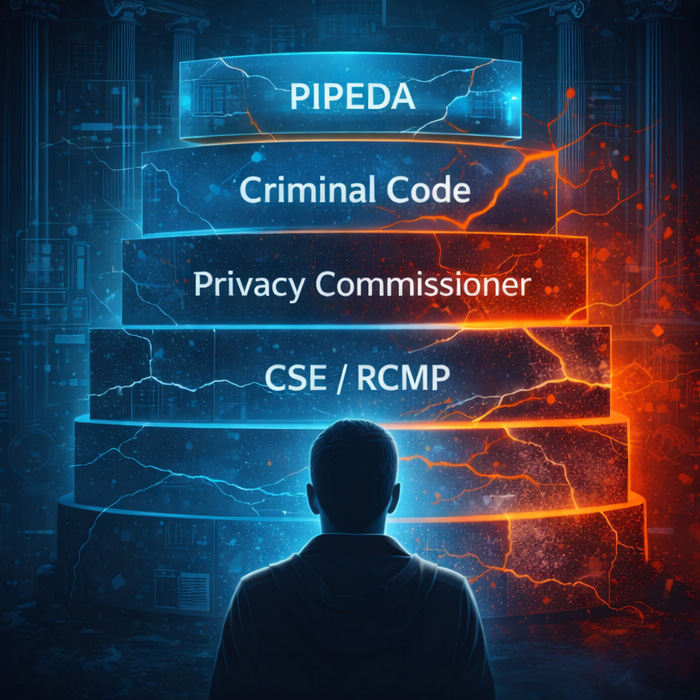
The structure of Cyber Law in Canada

The structure of Cyber Law in Canada

When Canadians hear the term cyber law, many assume it’s a single, clear set of rules designed to protect them online. In reality, cyber law in Canada is a patchwork of laws, regulators, and agencies — each responsible for a specific slice of the digital world. Understanding who does what is the first step to understanding where protection exists, and where it doesn’t.

RELATED POSTS

What Canadian ISPs Log – and For How Long

Let’s start at the top.

The Top-Level Federal Law: Privacy and Data Protection

At the federal level, the most important cyber-related law affecting everyday Canadians is PIPEDA – the Personal Information Protection and Electronic Documents Act. In simple terms, PIPEDA governs how private-sector organizations collect, use, and store personal information in the course of commercial activities. If a company operates across provincial borders, or online, PIPEDA almost certainly applies.

PIPEDA is built on a few basic principles:

  • Companies must have a reason to collect your data
  • They should only collect what they need
  • They must protect it
  • They should tell you what they’re doing with it
  • You have the right to access and correct it

That’s the theory. Enforcement is another story.


What Falls Under PIPEDA?

Under PIPEDA, “personal information” is defined broadly. It includes:

  • Names, email addresses, phone numbers
  • Financial and billing data
  • Health and genetic information
  • IP addresses and online identifiers (in many cases)


If a company loses this data in a breach, it must:

  • Assess the risk of harm
  • Notify affected individuals if there is “real risk of significant harm”
  • Report serious breaches to the Privacy Commissioner

However, PIPEDA does not directly punish companies. This is a key limitation many Canadians don’t realize.


The Privacy Commissioner of Canada: Oversight, Not Enforcement

The Office of the Privacy Commissioner of Canada (OPC) is the main federal privacy regulator. Its job is to:

  • Investigate complaints from individuals
  • Audit organizations
  • Make findings and recommendations
  • Educate the public

What it cannot currently do (under PIPEDA):

  • Issue fines on its own
  • Order companies to change practices immediately
  • Force compensation

The OPC functions more like a watchdog and ombudsman than a police force. It can publicly shame, pressure, and recommend – but enforcement is limited.
This is one reason Canada has been pushing for reform through Bill C-27, which would introduce stronger enforcement powers and penalties. Until that happens, protection remains largely reactive.


Criminal Law: When Cyber Issues Become Crimes

Cyber law isn’t only about privacy. When activities cross into criminal territory – hacking, fraud, ransomware – the Criminal Code of Canada applies.

This is where law enforcement comes in.


NC3 and Law Enforcement: Chasing the Criminals

The Canadian Centre for Cyber Security (Cyber Centre), part of the Communications Security Establishment (CSE), focuses on defensive cybersecurity. It:

  • Protects federal government systems
  • Advises critical infrastructure (energy, telecom, finance)
  • Issues alerts and guidance

It does not investigate individual crimes or help victims directly.

That role belongs to the National Cybercrime Coordination Centre (NC3), run by the RCMP. NC3 role is to:

  • Collects cybercrime reports from Canadians
  • Coordinates investigations across police forces
  • Works with international partners

Important to understand: NC3 coordinates – it does not guarantee investigation. Many reports help with intelligence gathering rather than immediate action.
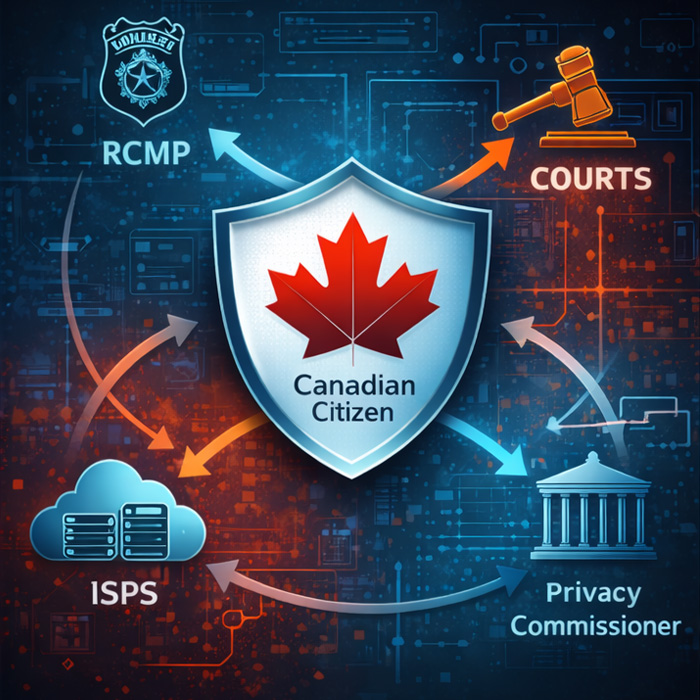
 

NC3 and Law Enforcement: Chasing the Criminals


Provincial Layers: Even More Complexity

On top of federal law, provinces may have:

  • Their own privacy laws (e.g., Quebec’s Law 25, Alberta and BC private-sector acts)
  • Provincial privacy commissioners
  • Provincial breach notification rules

Depending on where you live and which organization holds your data, different laws may apply.


The Big Picture: Why This Feels Confusing

Cyber law in Canada isn’t broken because people don’t care – it’s fragmented because it evolved piecemeal.
In plain English:

  • Privacy law governs how companies should handle your data
  • Privacy commissioners oversee and investigate
  • Police handle crimes after damage is done
  • Cybersecurity agencies focus on protecting systems, not people

There is no single authority “in charge of protecting Canadians online.” Understanding this structure doesn’t solve the problem – but it does explain why, when a breach happens, accountability often feels slow, distant, or incomplete. And that’s exactly why cyber law and policy deserve closer scrutiny.


 SIDEBAR

Why This Matters to Canadians

When a data breach happens, many Canadians instinctively ask: Who is protecting me? The uncomfortable answer is: no single entity is fully responsible.

Canada’s cyber law framework was built to guide organizations, not aggressively police them. Privacy commissioners can investigate, but often cannot fine. Police can act, but usually only after harm occurs. Cybersecurity agencies protect systems, not individuals.

This matters because once your personal data is exposed, it cannot be “put back.” Credit monitoring expires. Settlements are symbolic. The long-term risk — identity theft, fraud, surveillance – stays with the individual.

Understanding how cyber law is structured helps Canadians see why accountability feels limited, why breaches keep happening, and why stronger enforcement is not a technical issue –  it’s a policy choice.
Tags: Canadian LawPrivacy LawPublic Interest
ShareTweetPin
Previous Post

The Absolute Basics: What “Personal Data” Actually Is

Next Post

Bitdefender Review: Solid Protection Without the Headaches

C0ld Signal

C0ld Signal

Related Posts

What Canadian ISPs Log – and For How Long
Latest News

What Canadian ISPs Log – and For How Long

January 23, 2026
Next Post
BitDefender Antivirus in action

Bitdefender Review: Solid Protection Without the Headaches

Northern Overwatch - Archives

Downloads

Please login to join discussion

Recommended Stories

LifeLabs sign outside a medical laboratory location in Canada, representing the LifeLabs data breach and patient privacy concerns

When Your Medical Data Leaks, There’s No Recall Button

January 25, 2026
Why Northern Overwatch Editorial

Why Northern Overwatch Exists

January 23, 2026
Canadian passport and smartphone wrapped in barbed wire symbolizing loss of privacy and digital rights

Privacy Is Not a Crime: Why Wanting Digital Privacy Doesn’t Make You a Suspect

February 12, 2026

Popular Stories

  • North Perth Hit by WorldLe@ks Data-Theft Operation

    North Perth Hit by WorldLe@ks Data-Theft Operation

    0 shares
    Share 0 Tweet 0
  • What Canadian ISPs Log – and For How Long

    0 shares
    Share 0 Tweet 0
  • Why Northern Overwatch Exists

    0 shares
    Share 0 Tweet 0
  • SkyGlobal – An investigation into power, privacy and surveillance

    0 shares
    Share 0 Tweet 0
  • When Your Medical Data Leaks, There’s No Recall Button

    0 shares
    Share 0 Tweet 0
Northern Overwatch Logo

Northern Overwatch is a Canadian investigative publication examining cybersecurity, privacy, surveillance, and digital power. We explain complex cyber incidents, laws, and technologies in plain English, exposing how they affect real people — and defending the right to privacy in an increasingly monitored world.

Recent Posts

  • Securing Your Laptop or PC: The First Privacy Settings Everyone Should Enable
  • Privacy Is Not a Crime: Why Wanting Digital Privacy Doesn’t Make You a Suspect
  • Sky Global – The Company That Defied Surveillance And Built Building a Private Network

ARTICLES

  • Archives
  • Cyber Law & Policy
    • Telecom Regulations
    • Your Rights as a Canadian
  • Editorial
  • Impact on Canadians
    • Breach Consequences
    • What It Means for You
  • Investigations
    • Featured Investigations
    • Surveillance & Power
  • Latest News
    • Data Breaches
  • Privacy How-To
    • Getting Started
  • Recommendations
    • Software & Tools

USEFUL LINKS

About Us

© 2025 Northern Overwatch - From the North — for those who still value privacy. A CanHack publication.

Welcome Back!

Login to your account below

Forgotten Password?

Retrieve your password

Please enter your username or email address to reset your password.

Log In
No Result
View All Result
  • Editorial
  • News
    • Critical Infrastructure
    • Data Breaches
    • Ransomware & Malware
    • Telecom & ISP Incidents
    • Government & Regulation
    • Updates & Follow-ups
  • Investigations
    • Featured Investigations
    • Surveillance & Power
    • Corporate Accountability
  • Impact on Canadians
    • Breach Consequences
    • What It Means for You
  • Privacy How-To
    • Getting Started
    • Devices & Apps
    • Advanced Privacy
  • Cyber Law & Policy
    • Your Rights as a Canadian
    • Surveillance & Lawful Access
    • Telecom Regulations
  • Recommendations
    • Books & Resources
    • Hardware & Devices
    • Software & Tools
  • Archives

© 2025 Northern Overwatch - From the North — for those who still value privacy. A CanHack publication.

Are you sure want to unlock this post?
Unlock left : 0
Are you sure want to cancel subscription?